Training time
1–2 years
State license
Required for most shop work
Michigan median pay
$61,420 a year
Openings per year
About 720
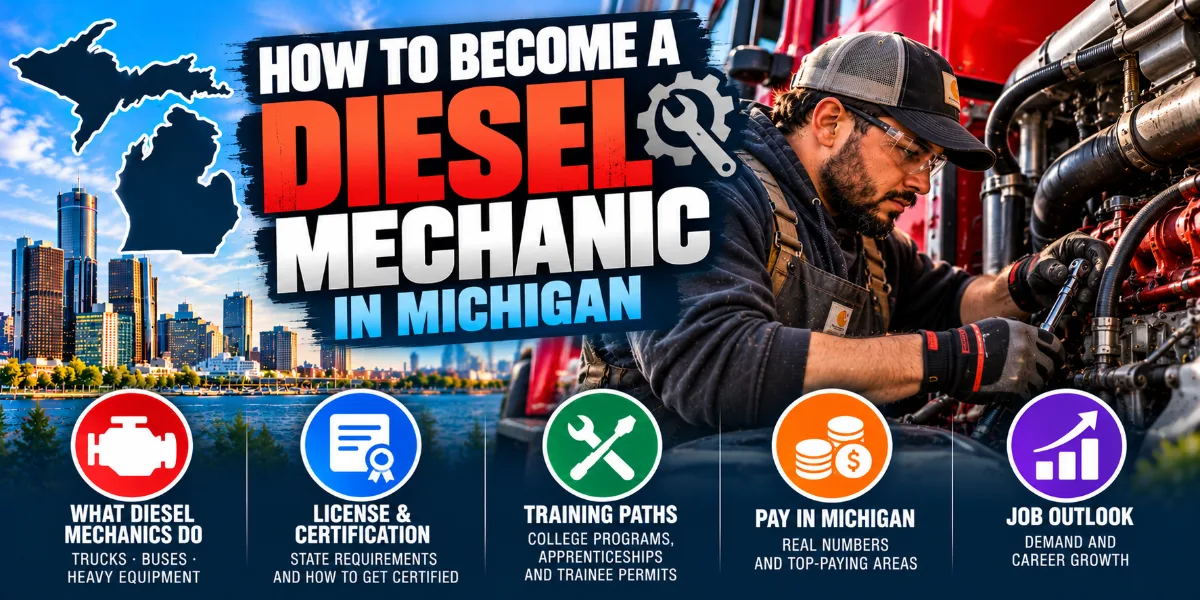
Diesel mechanics keep trucks, buses and heavy equipment running. In Michigan, you can’t just pick up a wrench and start charging for heavy truck repairs. The state requires most mechanics to be certified by the Michigan Department of State (SOS). This guide covers the rules, the pay, the schools and the steps to get started.
Quick answer
- Time: most college diesel programs run about 1 to 2 years. You can work as a trainee while you finish state tests.
- Cost: state tests are $18 each, the certification application is $25 and a trainee permit is $20. School tuition is extra and varies by college.
- License: Michigan requires state mechanic certification for anyone repairing vehicles for pay, with some exemptions such as in-house fleet shops.
- Pay: the Michigan median is $61,420 a year ($29.53 an hour), close to the national median of $61,770.
From the dean’s desk
Diesel works pretty much the same anywhere in the country, but you have to get a firm grasp on emissions systems. That’s the most important part.
— Lester Burkes, Dean of Trades, Transportation & Apprenticeship
What a diesel mechanic does
Diesel mechanics inspect, diagnose and repair trucks, buses and other diesel-powered equipment. A typical day might include tracing an electrical fault, rebuilding air brakes, replacing a fuel system part or doing preventive maintenance so a truck stays on the road. You work in dealership shops, independent repair shops, fleet garages and on equipment in the field.
Today’s trucks are full of computers, so diagnostic skills matter as much as muscle. Mechanics who can read wiring diagrams and use scan tools are in demand.
Michigan license and certification requirements
Michigan’s Motor Vehicle Service and Repair Act (Act 300 of 1974) requires certification for anyone who repairs vehicles for pay. That includes diagnosing, adjusting and replacing major-repair parts. There is no grandfather clause, so experienced mechanics moving here still have to pass the state tests or transfer qualifying ASE certifications. (Michigan SOS)
The six heavy-duty truck categories
Michigan certifies heavy-duty truck mechanics in six categories. Pass all six and you are a Master Heavy-duty Truck Mechanic. Pass fewer and you are a Specialty Mechanic in the categories you hold.
- Gasoline Engine Repair
- Diesel Engine Repair
- Drivetrain
- Brakes and Braking Systems (heavy on air brakes)
- Suspension and Steering Systems (includes fifth wheel)
- Electrical Systems
The state splits mechanic certification into an automobile and light truck class and a separate heavy-duty truck class, based on vehicle weight. SOS documents don’t all give the same weight cutoff, so if you work on mid-size trucks, ask SOS which class applies.
Trainee permits
If you aren’t certified yet, you need a trainee permit ($20) to do major repairs. It is good for two years, can’t be renewed, and you must work under the direct supervision of a mechanic certified in the same category. Processing takes about 30 days.
State tests and fees
- Tests are taken on touch-screen kiosks at Secretary of State offices by appointment. Some approved automotive schools can test their own students.
- You must pre-register before each test and take it within the time SOS gives you.
- Most tests have about 55 multiple-choice questions. Passing is 65% or higher, depending on the test. You get one try per category per day.
- Fees: $18 per test (including retakes), $25 for the certification application and $20 for a trainee permit.
Fleet shop exemption
The law does not apply to people who work only for a single commercial, industrial or government employer on that employer’s vehicles. Many in-house truck fleet techs may be exempt. Dealer and independent shop techs who repair customers’ trucks need certification. If you work in a fleet, confirm your status with your employer and SOS.
Where ASE fits
ASE certification is voluntary, but many employers look for it. ASE’s medium-heavy truck series runs from T1 to T8, and Master Medium-Heavy Truck Technician status takes T2 through T8. ASE alone does not make you a Michigan-certified mechanic, but some ASE certifications can be transferred in place of state tests. Student-level ASE tests don’t count. (ASE)
A CDL is not legally required to be a diesel mechanic, but having one can help when a shop needs someone to road-test trucks.
How much diesel mechanics make in Michigan
Michigan diesel mechanics (bus and truck mechanics and diesel engine specialists) earned a median of $61,420 in May 2025. Ann Arbor and the Detroit area paid the most among the state’s major metros.
| Area | Median pay (May 2025) | Hourly |
|---|---|---|
| United States | $61,770 | $29.70 |
| Michigan | $61,420 | $29.53 |
| Detroit–Warren–Dearborn | $63,360 | $30.46 |
| Grand Rapids–Wyoming–Kentwood | $61,240 | $29.44 |
| Lansing–East Lansing | $61,740 | $29.69 |
| Ann Arbor | $65,770 | $31.62 |
Source: O*NET OnLine, BLS OEWS May 2025
The top 10% of Michigan diesel mechanics earned about $81,010 or more. Outside the big metros, medians were about $63,240 in Traverse City, $61,780 in Flint and $58,210 in the Upper Peninsula nonmetro area.
Job outlook in Michigan
Michigan had about 8,710 diesel mechanic jobs in 2024 and is projected to have about 8,880 by 2034, growth of about 2%. The bigger number is openings: about 720 a year as mechanics retire or change jobs. That matters in a state where total employment is projected to grow only 0.4% over the same period.
Nationally, BLS projects 4% growth from 2025 to 2035, about as fast as average, with roughly 24,400 openings a year.
Training paths in Michigan
Earn while you learn
Many diesel techs start in a shop as a helper or lube tech and work toward certification on a trainee permit, under a certified mechanic. Ask employers whether they pay for school, tools or ASE tests. Formal registered diesel apprenticeships in Michigan vary by employer, so check what is open now.
See which Michigan apprenticeships are accepting applications right now: Michigan Apprenticeship Tracker
College diesel and heavy equipment programs
These Michigan schools offer diesel or heavy equipment technician programs, listed in alphabetical order. Program details change, so confirm cost, schedule and start dates with each school.
- Baker College, Auto/Diesel Institute of Michigan (Owosso): Diesel Service Technology AAS, 60 credits, about four semesters. ASE Education Foundation accredited.
- Delta College (University Center): Heavy Duty Diesel Service Technology AAS, which includes an ASE certification exam.
- Ferris State University (Big Rapids): Heavy Equipment Technology AAS covering diesel engines, hydraulics, brakes and power transmission for trucking, construction and farm equipment, plus a bachelor’s option in Heavy Equipment Service Engineering Technology.
- Kalamazoo Valley Community College (Kalamazoo): an Auto Light Duty Diesel Engines certificate for students focused on light-duty diesel work.
- Kirtland Community College (Grayling area): Automotive Technology Diesel Service Specialist certificate covering diesel engines, heavy-duty brakes, suspension and steering, and hydraulics.
- Lansing Community College (Lansing): Heavy Equipment Repair Technician certificate (41 credits) with courses in heavy engine rebuild and diesel fuel systems. Credits can apply to an associate degree.
When you compare programs, ask how much shop time you get, which ASE and state tests you can take, and where recent graduates got hired.
Step-by-step: how to become a diesel mechanic in Michigan
1
Finish high school or a GED
BLS lists a high school diploma or equivalent as the typical entry education. Math, electronics and shop classes help.
2
Choose a training path
Enroll in a college diesel program or start in a shop as a helper. Many techs do both.
3
Get a trainee permit
Apply to SOS for a $20 trainee permit so you can do major repairs under a certified mechanic while you learn.
4
Pass the state heavy-duty tests
Pre-register, then test at a Secretary of State office or an approved school. Aim for all six categories to reach Master Heavy-duty Truck Mechanic.
5
Add ASE certifications
Once you have the experience ASE requires, take the T-series tests. Some can also transfer to your Michigan certificate.
6
Keep learning
New engines, emissions systems and electronics keep changing the job. Techs who keep training move into the better-paying roles.
Frequently asked questions
Do diesel mechanics need a license in Michigan?
Yes, if you repair heavy trucks for pay. Michigan has six heavy-duty truck categories, including a separate Diesel Engine Repair test. In-house fleet techs who work only on their employer’s vehicles may be exempt.
Can I work while I’m getting certified?
Yes. A $20 trainee permit lets you do major repairs for two years under the direct supervision of a mechanic certified in the same category. It can’t be renewed.
Does ASE count in Michigan?
Not by itself. Some ASE certifications can be transferred in place of state tests by having myASE send a status letter to SOS. Student-level ASE tests don’t qualify.
How much do diesel mechanics make in Michigan?
The median was $61,420 a year ($29.53 an hour) in May 2025. Ann Arbor ($65,770) and Detroit ($63,360) were the highest among major metros.
What are the state tests like?
They are computer-based and multiple choice, usually about 55 questions, taken at a Secretary of State office. Passing is 65% or higher depending on the test, and each attempt costs $18.
Do I need a CDL to be a diesel mechanic?
No, but it can help. Some shops like techs who can road-test trucks.
Sources
- Michigan Department of State: Mechanics
- Michigan Department of State: Mechanics FAQ
- Michigan Department of State: Mechanic testing
- ASE: Medium-Heavy Truck tests (T1–T8)
- BLS Occupational Outlook Handbook: Diesel Service Technicians and Mechanics
- O*NET OnLine: Bus and truck mechanic wages in Michigan (BLS OEWS May 2025)
- O*NET OnLine: Bus and truck mechanic projections in Michigan
- Michigan Center for Data and Analytics: Statewide projections to 2034

Leave a Reply