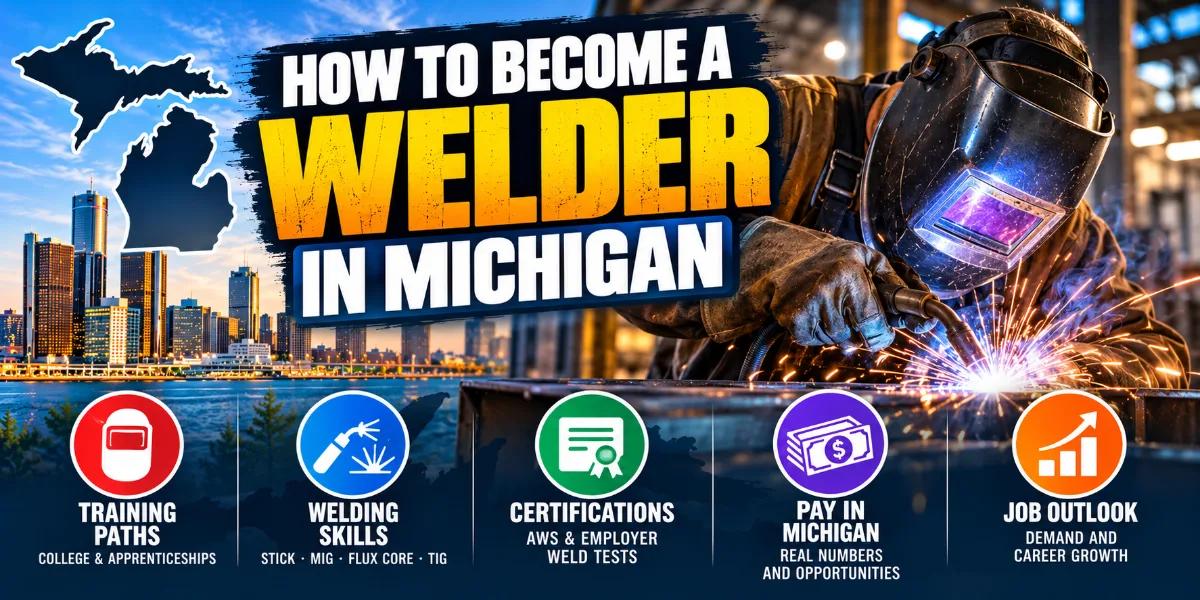
Quick answer: welder in Michigan
- Time: about 1 semester for a short certificate, or 1 to 1½ years for a full welding certificate. Union apprenticeships that include welding take several years, with pay while you train.
- Cost: community college is usually the lowest-cost route. Check each college’s current tuition.
- License: employers mostly hire on certifications and weld tests. The City of Detroit has its own welder license for work inside the city.
- Pay: Michigan median of $49,990 a year ($24.03 an hour), and $54,180 in the Ann Arbor area (O*NET OnLine, May 2025 data).
- Openings: about 1,320 welding jobs open up in Michigan each year.
Michigan builds cars, trucks, machines and steel structures, and all of that takes welders. You can start with a short community college certificate, add certifications as you go, and keep moving up. This guide covers the rules, the pay, and the schools and programs that can get you hired.
From the dean’s desk
When you look for a training location, you need to ask what certification standards they teach to. You should really want a training program that teaches to AWS standards and helps you get your AWS certifications.
— Lester Burkes, Dean of Trades, Transportation & Apprenticeship
What a welder does
Welders join and cut metal using heat. On a typical day you might read a blueprint, set up your machine, fit parts together, lay a weld and check it for defects. Welders work in factories, fab shops, shipyards, construction sites and repair shops.
Most welders specialize in one or more processes:
- SMAW (stick): common in construction and repair.
- GMAW (MIG): fast and common in manufacturing.
- FCAW (flux core): used on heavy steel and outdoors.
- GTAW (TIG): precise work on thin metal, stainless and aluminum.
The job is physical. You’ll work around heat, sparks and fumes, so safety gear and training matter. Good welders also have steady hands, sharp eyesight and patience. Reading blueprints and weld symbols, measuring accurately and fitting parts together are just as important as the weld itself.
Michigan license and certification requirements
Most Michigan employers do not ask for a license. They ask you to prove you can weld, usually by passing their weld test or showing a certification.
- City of Detroit welder license: Detroit’s Buildings, Safety Engineering and Environmental Department (BSEED) tests and licenses welders. The city says its trade licenses are required to perform work in the City of Detroit. The welding performance test is done offsite and the results are sent to the city. To schedule an exam, call Trade Licensing and Testing at 313-224-3202. See Detroit’s building license page.
- AWS certifications: the American Welding Society (AWS) runs the most common welder certifications. Some Michigan colleges teach to AWS SENSE standards. For example, Mid Michigan College offers AWS SENSE Level I, with a separate certificate for each process (SMAW, GMAW, GTAW and FCAW).
- Employer weld tests: many shops test you on their own material and positions before they hire you. Some employers pay for training and testing.
- Safety rules: welding work in Michigan falls under MIOSHA’s General Industry Safety Standard Part 12, “Welding and Cutting.” BLS also notes that OSHA requires welders to complete electrical safety training.
Certifications are tied to the process and position you tested in. Plan to test again as you add new skills.
How much welders make in Michigan
Michigan welders earned a median of $49,990 a year in May 2025. That is below the national median of $53,750. Pay is higher in the Ann Arbor area, and the Bay City area had a median of $57,760.
| Area | Median annual pay | Median hourly |
|---|---|---|
| United States | $53,750 | $25.84 |
| Michigan | $49,990 | $24.03 |
| Detroit–Warren–Dearborn | $51,810 | $24.91 |
| Grand Rapids–Wyoming–Kentwood | $48,920 | $23.52 |
| Lansing–East Lansing | $50,370 | $24.22 |
| Ann Arbor | $54,180 | $26.05 |
Source: O*NET OnLine, BLS OEWS May 2025
Hourly figures are the annual median divided by 2,080 hours. Welders who add pipe, structural or TIG skills can move toward the top of the pay range.
Job outlook in Michigan
Michigan expects the number of welding jobs to dip about 2% from 2024 to 2034, from about 14,210 to 13,860. Even so, the state projects about 1,320 openings a year as welders retire or change jobs.
Nationally, BLS projects about 2% growth from 2025 to 2035, with about 40,300 openings a year. Most of those openings come from replacing workers who leave.
Training paths in Michigan
Community college welding programs
Community colleges are the most common starting point. Programs vary in length, cost and schedule, so compare a few. Here are two examples we checked on the colleges’ own websites:
- Mid Michigan College (Harrison and Mt. Pleasant): a 35-credit Certificate in Welding (about 1 to 1½ years), a Welding Training Credential (about 1 year), a 120-hour short-term training option, a 4-course pre-apprenticeship certificate pathway and AWS SENSE Level I.
- Delta College (University Center): a 16-credit Welding Certificate of Achievement you can finish in one semester. Delta calls it an AWS SENSE certified program. It leads into an advanced certificate, and Delta offers classes at night, on weekends and online.
Many other Michigan community colleges also teach welding. Use the button below to compare schools near you.
Apprenticeships that include welding
Some union apprenticeships teach welding as part of a larger trade, including ironworkers, boilermakers and pipefitters. You earn a paycheck while you learn, and your pay rises as you gain hours. Each program sets its own application dates and requirements, so check with the local that covers your area.
See which Michigan apprenticeships are accepting applications right now: Michigan Apprenticeship Tracker
How to compare welding programs
- Booth time: ask how many hours you will actually spend welding, not just in lectures.
- Certifications: ask which AWS-based certifications you will test for before you finish.
- Schedule: check for night, weekend or short-term options if you need to keep working.
- Cost: compare tuition, fees, gear and testing costs, and ask about financial aid.
- Job results: ask where recent graduates got hired and what they earn.
Step-by-step: how to become a welder in Michigan
1
Finish high school or a GED
Shop class, math and blueprint reading give you a head start. Some colleges offer welding classes to high school students.
2
Pick a training path
Choose a community college certificate, a short-term program, or an apprenticeship that includes welding.
3
Learn the main processes
Get comfortable with stick, MIG, flux core and TIG. Most jobs want at least two.
4
Earn certifications
Test for AWS-based certifications in the processes local employers use. If you’ll work in Detroit, ask about the city’s welder license.
5
Pass a weld test and get hired
Many employers test you before they hire. Show up on time, ready to work, and keep adding skills to raise your pay.
Frequently asked questions
Do you need a license to weld in Michigan?
Most employers hire on certifications and weld tests. The City of Detroit is an exception: it tests and licenses welders for work done in the city. Call Detroit Trade Licensing and Testing at 313-224-3202.
How much do welders make in Michigan?
The median was $49,990 a year ($24.03 an hour) in May 2025. The Detroit-area median was $51,810, and the Ann Arbor-area median was $54,180.
Is welding a good career in Michigan?
Michigan expects a small dip in total welding jobs from 2024 to 2034, but still about 1,320 openings a year. Skilled welders with good certifications are still in demand.
How long does welding school take in Michigan?
It depends on the program. Delta College’s Welding Certificate of Achievement is 16 credits and can be done in one semester. Mid Michigan College’s Certificate in Welding is 35 credits, about 1 to 1½ years.
Can I get AWS credentials at a Michigan community college?
Yes. Mid Michigan College offers AWS SENSE Level I with certificates in SMAW, GMAW, GTAW and FCAW. Delta College describes its welding certificate as an AWS SENSE certified program.
What safety rules apply to welders in Michigan?
MIOSHA’s General Industry Safety Standard Part 12, “Welding and Cutting,” covers welding safety in Michigan workplaces, including confined spaces, gas cylinders, hoses and arc welding.
Sources
- O*NET OnLine: Welder wages in Michigan (BLS OEWS May 2025)
- O*NET OnLine: Welder employment trends in Michigan (2024–2034)
- BLS Occupational Outlook Handbook: Welders, Cutters, Solderers, and Brazers
- City of Detroit BSEED: Building license information
- MIOSHA General Industry Part 12: Welding and Cutting
- Mid Michigan College: Welding
- Delta College: Welding Certificate of Achievement

Leave a Reply