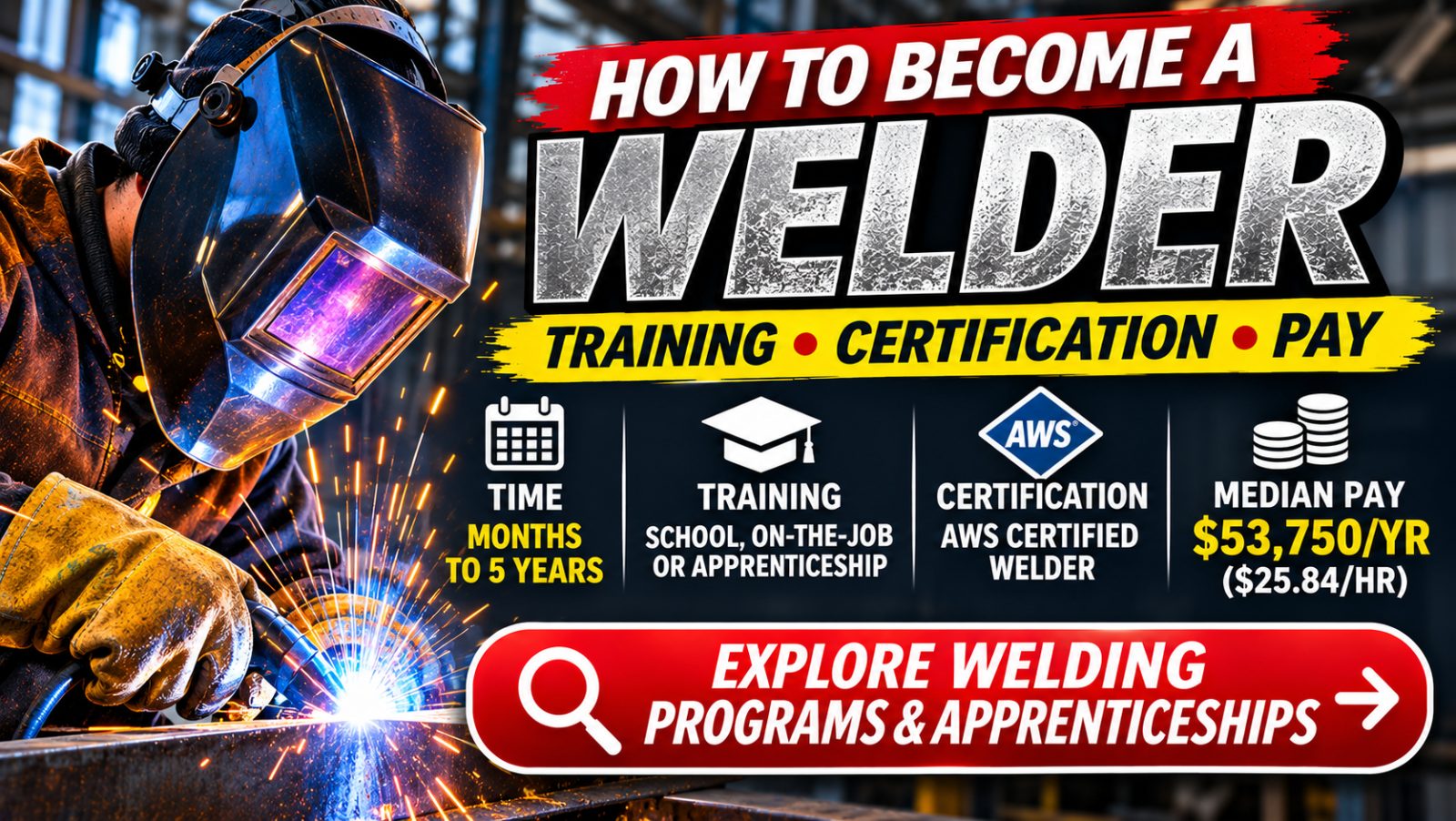
Welders join metal parts using heat. You’ll find them in factories, shipyards, pipelines, construction and repair shops. O*NET rates the outlook slower than average, but with about 40,300 openings projected each year, there’s still steady demand. Many of the best-paid welders weld as part of another trade, like pipefitting or boilermaking.
This guide covers how to train, how welding certification works, how long it takes, pay, and programs taking applications.
Pay figures are 2025 national medians from O*NET OnLine. Program details come from each program’s own website or state listing, checked by our tracker team. Always confirm on the program’s site before you apply.
How to become a welder, step by step
- Decide what kind of welding you want. Shop and production welding, structural, or pipe welding. It shapes your path.
- Get trained. Take a welding program at a community college or trade school, get hired as a trainee, or join an apprenticeship that includes welding.
- Practice the main processes. Most training covers stick (SMAW), MIG (GMAW), flux-core (FCAW) and TIG (GTAW).
- Pass a weld test. Employers test you on the process and position the job needs. A certification like AWS Certified Welder proves it.
- Keep your certification active. AWS requires you to submit maintenance records on a set schedule.
- Add skills to move up. Pipe welding, blueprint reading and inspection can lead to higher pay.
Three ways to become a welder
Welding is unusual: school is a common starting point, but apprenticeships still pay off.
| Union apprenticeship | Non-union apprenticeship | School first | |
|---|---|---|---|
| Who runs it | Union locals of pipefitters (UA), boilermakers and ironworkers | Contractor groups (such as ABC) and employers | Community college or trade school |
| Paid while you learn? | Yes | Yes | No, unless you also work |
| What you weld | Pipe, plate and structural steel on big jobs | Depends on employer | Learn all main processes |
| Cost | Low | Varies | Tuition, gear and materials |
| Best for | Long career with high-end welding work | Getting started near home | Learning fast and getting certified |
Paying for school? See how to pay for trade school.
How welding certification works
There’s no single “welding license.” Instead, you certify on specific tests. The best-known national program is the AWS Certified Welder program from the American Welding Society.
- No prerequisites: AWS says there are no education or minimum experience requirements.
- Hands-on test: You weld a test piece at an AWS Accredited Test Facility, and a Certified Welding Inspector checks it.
- Retests: AWS says there’s no limit on retests.
- Staying certified: You must submit maintenance records on schedule. AWS’s pages describe this as every six months; confirm the current rule with AWS or your test facility.
- Cost: Set by each test facility.
Many employers also run their own weld tests to codes like AWS D1.1 (structural) or ASME Section IX (pressure piping). Each test covers a process, metal and position, so welders often hold several certifications.
How long does it take to become a welder?
It depends on the path. School programs run from a few months for a certificate up to two years for an associate degree. On-the-job trainees can start production work quickly. Apprenticeships that include welding, like pipefitting, take four to five years; UA Local 189’s plumber, pipefitter and welder program, for example, is five years.
You can take a certification test as soon as you can pass it. There’s no required number of hours for the AWS Certified Welder test.
Tests you’ll face
The real test is the weld test: you weld a sample, then it’s inspected or cut and bent to check for flaws.
Apprenticeships may also give a math and mechanical reasoning test. Try our free mechanical aptitude practice test.
How much do welders make?
O*NET lists the 2025 national median pay for welders, cutters, solderers and brazers at $25.84 an hour, or $53,750 a year.
Pay varies a lot by type of work. Welders who work in the pipe and boilermaker trades are paid on those trades’ scales. For comparison, O*NET’s 2025 median is $30.67 an hour for plumbers, pipefitters and steamfitters, and $36.74 an hour for boilermakers. Check each program’s posted wage scale.
Welding apprenticeships taking applications
These update automatically from our free state trackers, which we check every week. Dates and requirements change, so confirm on the program’s site before you apply.
33 welding apprenticeships are open, opening soon or taking applications year-round across our state trackers. Pick your state: · Arkansas · California · Florida · Hawaii · Indiana · Minnesota · New Jersey · New York · Ohio · Pennsylvania · Texas · Washington
We track programs in Arkansas, California, Hawaii, Idaho, Illinois, Indiana, Michigan, New York, Ohio, Oregon, Pennsylvania, Texas and Washington. Each tracker is free and updated every week.
Welder jobs hiring now
Welding jobs from our free job board, updated every morning.
Browse trades jobs hiring now →
Welding by state
States generally don’t license welders the way they license electricians or plumbers. Some cities and some kinds of work (like structural steel or pressure piping) need specific certifications.
See our guides for California, Michigan and Washington, and our State Guides page.
Types of welders
Where you weld changes your day, your pay and your training:
- Factories and shopsProduction / fabrication welderWelds parts and products in a shop, often the same kinds of welds every day.
- Buildings and bridgesStructural welderWelds steel beams and columns, often working alongside ironworkers.Read the ironworker guide →
- Pipelines and plantsPipe welderWelds pipe to tough codes. Usually trained through pipefitter (UA) programs.Read the plumber and pipefitter guide →
- Boilers and tanksBoilermakerWelds and builds boilers, tanks and pressure vessels. It’s its own apprenticeship.Read the boilermaker guide →
- Under the waterUnderwater welderA small, specialized field that also needs commercial diving training.
- Quality checksWelding inspectorExperienced welders can become Certified Welding Inspectors who check others’ work.
Dean’s take
“Trades are going to be some of the most sought-after jobs in the next 5 to 10 years. Becoming a welder will put you at the forefront of one of the most AI-resistant careers out there.”
Lester Burkes, Dean of Trades, Transportation and Apprenticeship
Welder FAQ
Can you become a welder without school?
Yes. Some employers train on the job, and apprenticeships teach welding as part of a trade. School just speeds up learning the basics.
Do I need experience to take the AWS test?
No. AWS says there are no education or experience prerequisites for the Certified Welder test. You just need to pass the weld.
How long is welding certification good for?
It depends on the program. For AWS Certified Welder, you must keep submitting maintenance records on schedule to stay active.
What’s the best-paying kind of welding?
Pipe and specialty welding usually pay more than production work, especially in union pipe trades.
Is welding hard to learn?
The basics can be learned in months. Passing tough code tests on pipe takes much longer.
Is welding the right trade for me?
Take our free skilled trades career assessment to compare welding with other trades.
Get new welding openings by email
We’ll email you when welding programs open in the states we track. Free, and you can unsubscribe anytime.
Thank you for your response. ✨
We are not affiliated with any program listed. Dates and requirements change; always confirm on the program’s own website before you apply.
Sources: O*NET: Welders, Cutters, Solderers, and Brazers · AWS Certified Welder FAQ · UA Local 189 JATC
