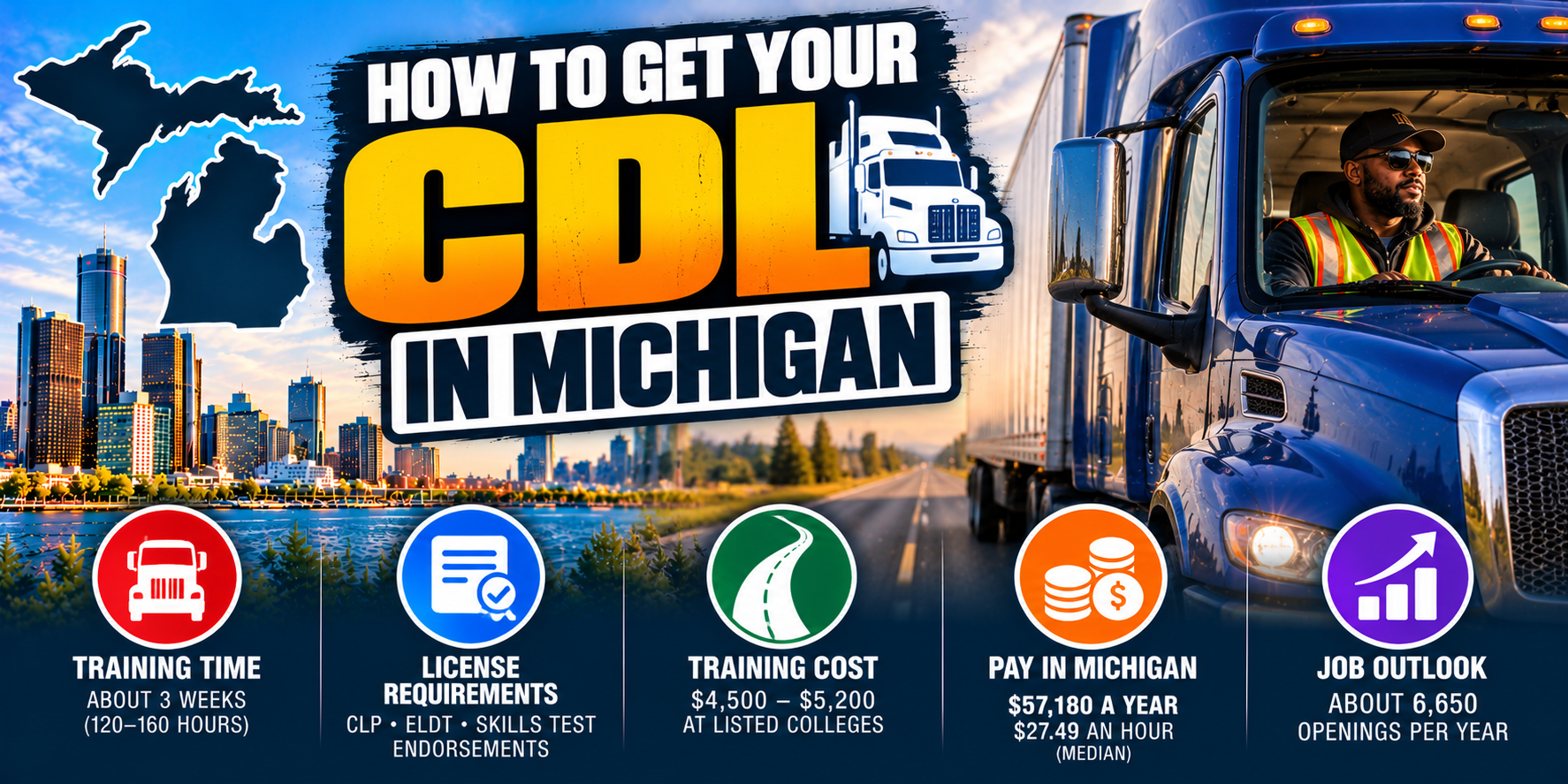
Training time
About 3 weeks
Program cost
$4,500–$5,200 at listed colleges
Michigan median pay
$57,180 a year
Openings per year
About 6,650
A commercial driver’s license (CDL) can get you into a steady-paying job fast. Michigan has thousands of truck driving openings every year, and many community college programs take about three weeks. Here is how the Michigan CDL process works, what it costs, what drivers earn and where to train.
Quick answer
- Time: most Class A training programs listed below run about three weeks (around 120 to 160 hours). You must hold your learner’s permit at least 14 days before the road test.
- Cost: Class A programs at the colleges below list $4,500 to $5,200, and Michigan Works! may cover some or all of it. Road test fees are set by the testing business.
- License: pass the knowledge tests for a commercial learner’s permit (CLP), finish federally required entry-level driver training (ELDT), then pass a skills test.
- Pay: Michigan heavy and tractor-trailer drivers earned a median of $57,180 a year (about $27.49 an hour).
From the dean’s desk
A CDL is still worth it, and I don’t see that changing anytime soon.
— Lester Burkes, Dean of Trades, Transportation & Apprenticeship
What CDL drivers do
CDL holders drive heavy trucks, tractor-trailers, buses and other large vehicles. Heavy and tractor-trailer drivers haul freight locally, regionally or across the country. They inspect their trucks, secure loads, keep logs and follow strict safety rules.
Michigan CDL groups
- Group A: combination vehicles of 26,001 pounds or more, towing a unit over 10,000 pounds (tractor-trailers).
- Group B: single vehicles of 26,001 pounds or more, like dump trucks and many buses.
- Group C: vehicles carrying 16 or more passengers or placarded hazardous materials.
Endorsements add more: T (doubles; triples aren’t allowed in Michigan), P (passenger), N (tank), H (hazmat), X (tank plus hazmat) and S (school bus).
Michigan CDL requirements
Who can apply
- You need a valid Michigan driver’s license and proof of legal presence and your Social Security number. Since September 29, 2025, Michigan issues CLPs and CDLs only with specific federal legal-presence documents, and non-domiciled CLPs and CDLs are paused.
- At 18 to 20, you can drive commercial vehicles only within Michigan. You must be 21 to drive across state lines or haul placarded hazmat.
- You must self-certify your type of driving and, for most interstate drivers, give SOS a current medical certificate.
Knowledge tests and your learner’s permit
Knowledge tests are taken on a computer at a Secretary of State office, and you need 80% to pass each one. Group A applicants take a 70-question general knowledge test plus a 20-question combination vehicle test. Groups B and C take 50 questions. Endorsement tests run 20 to 30 questions, and the air brakes test is 25. You can take one test per category per day. (Michigan SOS)
Passing gets you a commercial learner’s permit (CLP), which is valid for one year. You then must practice for at least 14 days with a CDL holder of the right class sitting beside you. CLP holders can’t haul hazmat.
Entry-level driver training (ELDT)
Since February 7, 2022, federal rules require ELDT before the skills test for a first Class A or B CDL, a class upgrade, and a first H, P or S endorsement. Hazmat theory must be done before the H knowledge test. Your trainer must be listed on the FMCSA Training Provider Registry. There is no minimum number of hours, but you must score 80% on the theory portion, and behind-the-wheel training must happen on a range and on public roads. Simulators don’t count. Completion is reported to the state electronically.
The skills test
The skills test has three parts: a pre-trip inspection, basic vehicle control and an on-road drive. You take it with an approved third-party testing business, not at SOS. Schedule it at least two days ahead. Testers set their own fees. For example, Kalamazoo RESA lists $175 for Class A and $150 for Class B or C, and you bring your own vehicle. Test in a vehicle with air brakes or you’ll get an air brake restriction. Passing results are good for one year.
Fees and hazmat
After you pass, you visit SOS for your new license and pay license fees, plus $5 for each endorsement. Ask SOS for your exact total, since it depends on your license type. Hazmat drivers must also pass a TSA background check ($86.50, paid to TSA). Apply 45 to 60 days ahead.
How much truck drivers make in Michigan
Michigan heavy and tractor-trailer truck drivers earned a median of $57,180 in May 2025, a little below the national median of $58,640. Detroit, Ann Arbor and Grand Rapids paid slightly above the state median.
| Area | Median pay (May 2025) | Hourly |
|---|---|---|
| United States | $58,640 | $28.19 |
| Michigan | $57,180 | $27.49 |
| Detroit–Warren–Dearborn | $59,120 | $28.42 |
| Grand Rapids–Wyoming–Kentwood | $58,270 | $28.01 |
| Lansing–East Lansing | $56,710 | $27.26 |
| Ann Arbor | $59,230 | $28.48 |
Source: O*NET OnLine, BLS OEWS May 2025. Michigan and metro hourly figures are annual medians divided by 2,080 hours.
Pay depends a lot on the type of driving. Over-the-road, specialized and hazmat jobs often pay more than local routes, but they also mean more time away from home.
Job outlook in Michigan
Michigan had about 64,400 heavy and tractor-trailer truck driver jobs in 2024 and is projected to have about 65,660 by 2034, growth of about 2%. The state expects about 6,650 openings a year, mostly from drivers retiring or leaving the field.
Nationally, BLS projects 4% growth from 2025 to 2035, with about 214,500 openings a year.
Training paths in Michigan
Employer-paid training
Some trucking companies, bus systems and public agencies train new drivers or repay school costs. Ask about any work commitment before you sign. Any Class A or B training still has to come from a provider on the FMCSA Training Provider Registry.
See which Michigan apprenticeships are accepting applications right now: Michigan Apprenticeship Tracker
Community college CDL programs
These Michigan colleges offer CDL training, listed in alphabetical order. Many partner with private schools such as Regen Trucking School and Trainco. Check each provider on the Training Provider Registry and confirm dates and costs before you enroll.
- Alpena Community College: non-credit CDL training with classroom and individually scheduled behind-the-wheel time ($4,500). The last session listed ran in July 2026; the next has not been announced.
- Glen Oaks Community College (Sturgis): CDL-A program with Regen Trucking School, 160 hours, about three weeks.
- Kirtland Community College (Grayling): Class A CDL taught by Regen Trucking School, three weeks and 160 hours ($5,200). A Class B bus driving course is also offered.
- Lake Michigan College (South Haven): Class A CDL with Regen Trucking School, three weeks and 160 hours ($5,200).
- Mid Michigan College (Mt. Pleasant): Class A and Class B CDL with Regen Trucking School. Class A is about three weeks ($5,200, including one road test attempt).
- Muskegon Community College: Class A and Class B CDL through Regen Trucking School. Class B is a one-week, 40-hour course.
- Washtenaw Community College (Ann Arbor): CDL-A training with Trainco in three-week sessions of classroom, skills pad and supervised driving, with small class sizes. Jackson College refers its CDL students to this program.
Michigan Works! may cover part or all of the cost at several of these programs. Ask your local Michigan Works! office before you pay out of pocket.
When you compare programs, ask how many hours you’ll spend behind the wheel, whether the road test is included, and which carriers hire their graduates.
Step-by-step: how to get your CDL in Michigan
1
Decide on the class you need
Most freight jobs need Class A. Bus and dump truck jobs may only need Class B.
2
Get your medical certificate and documents
Gather proof of legal presence and your Social Security number, and get a DOT medical exam if your driving type requires it.
3
Pass the knowledge tests
Study the Michigan CDL manual and score 80% or better on each test at an SOS office to get your CLP.
4
Complete ELDT
Finish theory and behind-the-wheel training with a provider on the FMCSA Training Provider Registry.
5
Practice for at least 14 days
Drive with a qualified CDL holder beside you while you hold your CLP.
6
Pass the skills test and get licensed
Book a road test with an approved third-party tester, then visit SOS to get your CDL.
Frequently asked questions
How old do you have to be to get a CDL in Michigan?
18 to drive only within Michigan, and 21 to drive across state lines or haul placarded hazmat.
Do I have to go to CDL school?
For a first Class A or B CDL, you must complete entry-level driver training with a provider on the FMCSA Training Provider Registry before the skills test. There is no minimum number of hours.
How long is a Michigan CLP good for?
One year. You must hold it at least 14 days before taking the skills test.
Where do I take the road test?
With an approved third-party driver testing business, not at a Secretary of State office. Testers set their own fees.
What score do I need on the written tests?
80% on every knowledge test.
How do I get a hazmat endorsement?
Be 21 or older, complete ELDT hazmat theory, pass the H knowledge test and pass a TSA background check ($86.50).
Can I pull triples in Michigan?
No. The T endorsement covers doubles. Triple trailers aren’t allowed in Michigan.
Sources
- Michigan Department of State: Applying for a CDL
- Michigan Department of State: CDL FAQ
- Michigan Legislature: MCL 257.306a (commercial learner’s permit)
- FMCSA Training Provider Registry: ELDT requirements
- Kalamazoo RESA: Commercial road skills test
- BLS Occupational Outlook Handbook: Heavy and Tractor-Trailer Truck Drivers
- O*NET OnLine: Heavy truck driver wages (BLS OEWS May 2025)
- O*NET OnLine: Heavy truck driver projections in Michigan


Leave a Reply