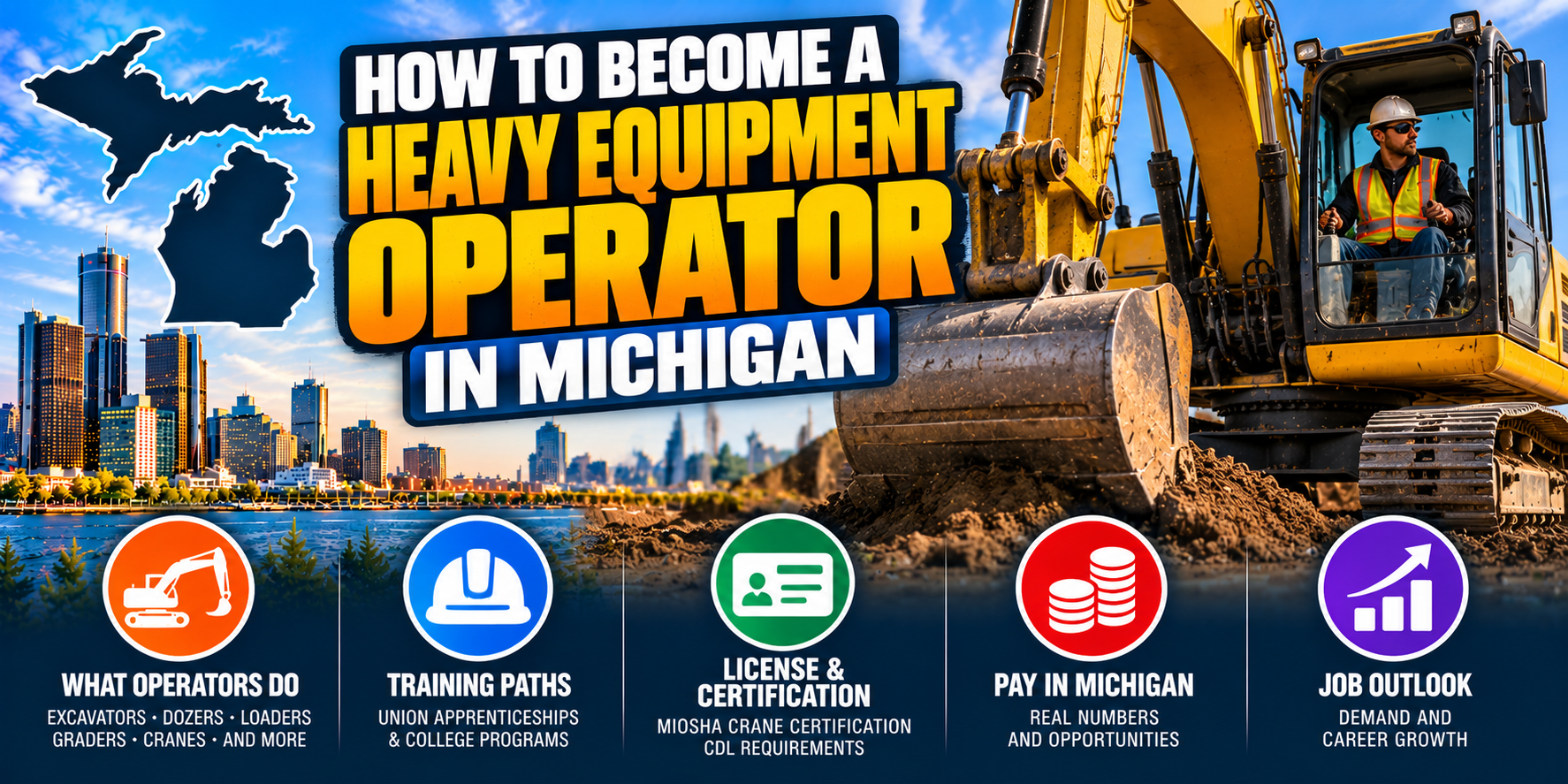
Quick answer: heavy equipment operator in Michigan
- Time: Operating Engineers Local 324’s operator apprenticeship is at least 3 years and 6,000 hours of paid work and classes.
- Cost: apprentices earn wages while they train. Check application details with the program you apply to.
- License: crane and boom truck operators in construction must be certified under MIOSHA. Many operators also need a CDL to haul equipment.
- Pay: Michigan median of $62,690 a year ($30.14 an hour), above the U.S. median (O*NET OnLine, May 2025 data).
- Openings: about 810 operator jobs open up in Michigan each year.
Heavy equipment operators build Michigan’s roads, bridges, pipelines and building sites. The pay is above the national median, and the main union apprenticeship trains you on a 560-acre site in Howell. The catch: Local 324 takes applications only during short windows, so you need to be ready when one opens.
From the dean’s desk
Reliability is everything. The crew needs you on site, and you’re not easy to replace. Your dependability and how well you communicate are your strongest assets.
— Lester Burkes, Dean of Trades, Transportation & Apprenticeship
What a heavy equipment operator does
Operators drive and control the machines that move earth and materials: excavators, bulldozers, loaders, backhoes, graders, rollers, pavers and cranes. On a typical day you might dig a trench, grade a road bed, load trucks or set materials with a crane.
You’ll also inspect your machine, do basic maintenance and follow signals from ground crews. The work is seasonal in much of Michigan, with long days in the construction season.
Michigan license and certification requirements
BLS notes that only a few states issue special licenses for operating backhoes, loaders and bulldozers. In Michigan, the rules to know are crane certification and the CDL.
- MIOSHA crane operator certification: under MIOSHA Construction Standard Part 10, “Cranes and Derricks,” employees who operate covered cranes in construction must be certified. Covered equipment includes truck, crawler, tower and mobile cranes, boom trucks, derricks and sideboom cranes. Excavators, backhoes, wheel loaders, track loaders, forklifts (unless hoisting with a winch or hook) and equipment rated 2,000 lbs or less are exempt from this rule. Employers must also make sure each crane operator is trained, certified or licensed, and evaluated.
- CDL for hauling equipment: operators often need a commercial driver’s license to haul machines to job sites. In Michigan, a Group A CDL covers combination vehicles of 26,001+ lbs that tow a unit over 10,000 lbs. Group B covers a single vehicle of 26,001+ lbs.
- CDL basics: first-time Group A and B applicants must complete Entry-Level Driver Training (ELDT) from an FMCSA-registered provider. You must hold your commercial learner’s permit for at least 14 days before the skills test. Drivers 18 to 20 can drive commercially only within Michigan.
How much heavy equipment operators make in Michigan
Michigan operating engineers and construction equipment operators earned a median of $62,690 a year in May 2025, above the national median of $59,850. Pay is highest in the Detroit area among the metros below. The Flint ($75,140) and Bay City ($75,310) areas were even higher.
| Area | Median annual pay | Median hourly |
|---|---|---|
| United States | $59,850 | $28.78 |
| Michigan | $62,690 | $30.14 |
| Detroit–Warren–Dearborn | $68,130 | $32.75 |
| Grand Rapids–Wyoming–Kentwood | $63,850 | $30.70 |
| Lansing–East Lansing | $61,390 | $29.51 |
| Ann Arbor | $62,490 | $30.04 |
Source: O*NET OnLine, BLS OEWS May 2025
Hourly figures are the annual median divided by 2,080 hours. Because the work is seasonal, overtime in the busy months can make a big difference in yearly pay.
Job outlook in Michigan
Michigan expects operator jobs to grow about 2% from 2024 to 2034, from about 9,640 to 9,870, with about 810 openings a year.
Nationally, BLS projects about 4% growth for construction equipment operators from 2025 to 2035, and about 5% for operating engineers specifically. A 3- or 4-year apprenticeship is a common way into the trade.
Training paths in Michigan
Union apprenticeship: Operating Engineers Local 324
International Union of Operating Engineers Local 324 runs Michigan’s main heavy equipment operator apprenticeship. Training happens at its Construction Career Center in Howell, a 560-acre heavy equipment training site with classrooms (toll-free 888-256-9610).
According to Local 324’s 2026 application notice, the Heavy Equipment Operator apprenticeship is at least 3 years and 6,000 hours of supervised work experience and related classroom instruction. The 2026 qualifications were:
- Age 17 or older
- High school diploma or GED at the time of application
- U.S. citizen or legal immigrant living in Michigan
- Valid Michigan driver’s license (required to complete an application)
- WorkKeys test scores, which must be supplied with the application
- Physically able to do the work and willing to take a physical
- Must meet drug screening requirements if selected
- Reliable transportation and willingness to travel to jobs anywhere in Michigan
When to apply: Local 324 accepts applications only during short windows, and applications are limited and first come, first served. The most recent windows were October 5–9, 2026 (CTE Direct Entry) and October 19–23, 2026 (general application). Both have closed, and the next window has not been announced. Watch oe324.org and get your diploma, driver’s license and WorkKeys scores ready ahead of time.
Local 324 says final acceptance depends on passing a physical and a drug test, and members earn benefits including pension, vacation and health insurance (career information).
See which Michigan apprenticeships are accepting applications right now: Michigan Apprenticeship Tracker
High school and other programs
Some Michigan career-tech centers introduce students to heavy equipment. For example, Eaton RESA’s Heavy Equipment Operation & Repair program is open to high school juniors and seniors. Students train at AIS Construction Equipment Company and can earn NCCER entry-level certification, CPR/First Aid and articulated college credit.
While you wait for the next Local 324 window, you can still build toward the trade. Finish your diploma or GED, take WorkKeys, keep a clean driving record and get comfortable working outdoors on job sites. Some people work as laborers or drivers for road and excavating contractors to learn how a job site runs.
Private operator schools also exist. Before you pay tuition, ask how many hours you’ll spend on real machines, which certifications you’ll earn, and where recent graduates got hired.
Step-by-step: how to become a heavy equipment operator in Michigan
1
Finish high school or a GED
You’ll need the diploma or GED in hand to apply to Local 324.
2
Get your Michigan driver’s license
It is required to apply. A clean driving record also helps if you go for a CDL later.
3
Take WorkKeys
Local 324 requires WorkKeys scores with your application. Take the test early so you are ready when a window opens.
4
Apply during the window
Watch oe324.org. Windows are short and spots fill on a first come, first served basis.
5
Train, earn and add credentials
Work through at least 6,000 hours of training. Add a CDL or crane certification to open up more jobs.
Frequently asked questions
Do I need a license to run heavy equipment in Michigan?
Crane and boom truck operators in construction must be certified under MIOSHA Part 10. Excavators, backhoes, loaders and similar machines are exempt from that crane rule. Many employers also want a CDL so you can haul equipment.
When does Local 324 take apprenticeship applications?
Only during short posted windows. The most recent were October 5–9, 2026 (CTE Direct Entry) and October 19–23, 2026. The next window has not been announced, so watch oe324.org.
What do I need to apply to Local 324?
For 2026: age 17+, a high school diploma or GED, Michigan residency, a valid Michigan driver’s license, WorkKeys scores and reliable transportation. You must also pass a physical and drug screening if selected.
Where does Local 324 train apprentices?
At its Construction Career Center in Howell, a 560-acre heavy equipment training site.
How much do heavy equipment operators make in Michigan?
The median was $62,690 a year ($30.14 an hour) in May 2025. The Detroit-area median was $68,130.
How long is the apprenticeship?
Local 324’s operator apprenticeship is at least 3 years and 6,000 hours of supervised work and classroom instruction.
Sources
- O*NET OnLine: Operating engineer wages in Michigan (BLS OEWS May 2025)
- O*NET OnLine: Operating engineer employment trends in Michigan (2024–2034)
- BLS Occupational Outlook Handbook: Construction Equipment Operators
- Operating Engineers Local 324: 2026 apprenticeship application (Oct 19–23)
- Operating Engineers Local 324: CTE Direct Entry application (Oct 5–9)
- Operating Engineers Local 324: Training
- Operating Engineers Local 324: Career information
- MIOSHA Fact Sheet: Crane operator certification (Part 10)
- MIOSHA Fact Sheet: Operator qualification and evaluation
- Michigan Secretary of State: Apply for a CDL
- Eaton RESA: Heavy Equipment Operation & Repair


Leave a Reply