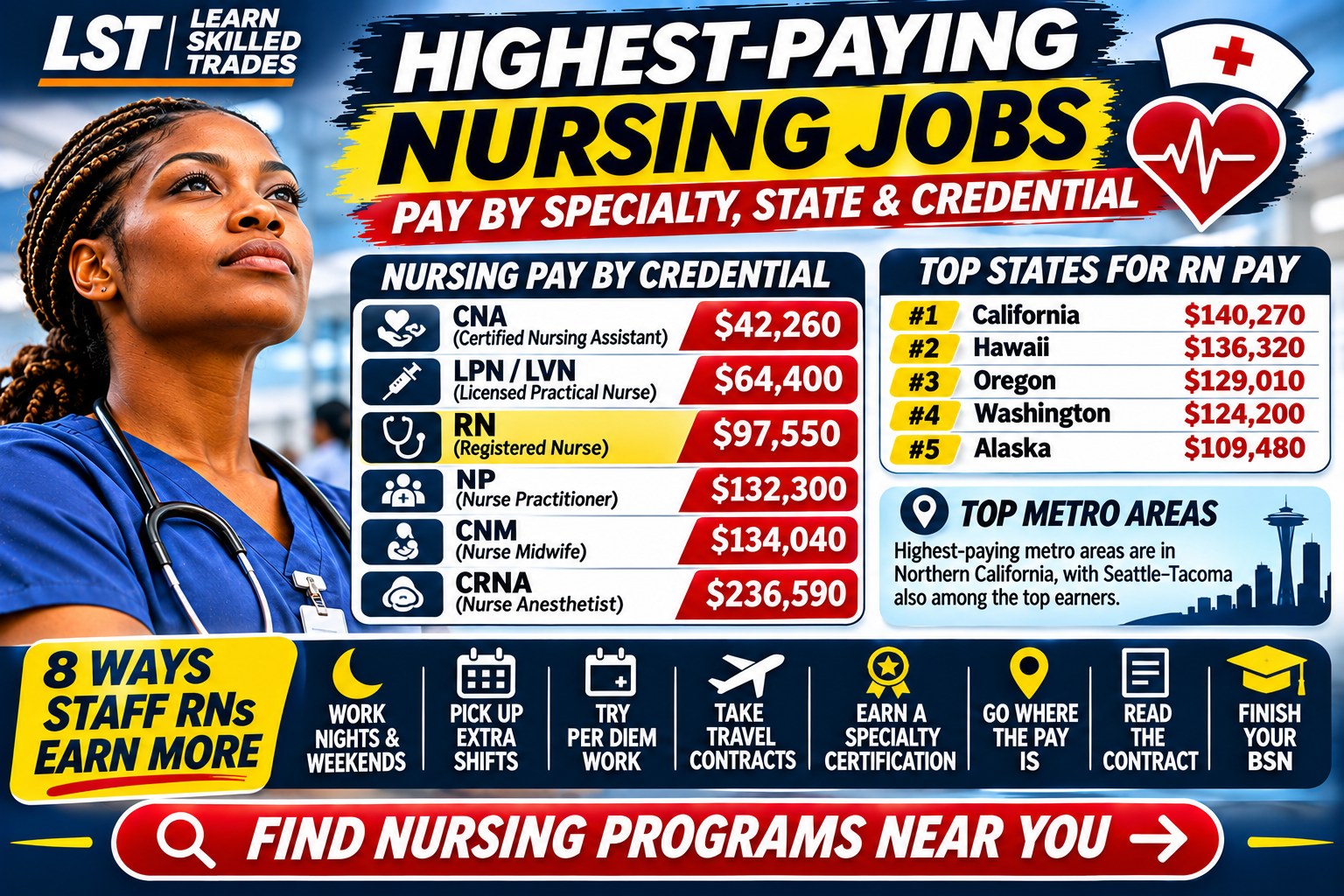
Many staff RNs earn well above the median without going back to school. They do it by picking the right shifts, the right location and the right certifications, more than by picking a “high-paying department.”
This guide covers pay at each credential level, whether your unit actually changes your paycheck, the highest-paying states and cities, and the practical ways nurses earn more. Every figure comes from federal wage data (BLS, May 2025), listed under Sources at the end.
Nursing pay by credential level
Your credential sets your pay range more than anything else. Each step up adds tens of thousands of dollars a year.
| Credential | Median pay (U.S.) | Typical schooling |
|---|---|---|
| Certified nursing assistant (CNA) | $42,260 | Short state-approved training program |
| Licensed practical/vocational nurse (LPN/LVN) | $64,400 | State-approved program, about 1 year |
| Registered nurse (RN) | $97,550 | Associate degree (ADN) or bachelor’s (BSN) |
| Nurse practitioner (NP) | $132,300 | Master’s degree or higher, plus RN license |
| Nurse midwife (CNM) | $134,040 | Master’s degree or higher, plus RN license |
| Nurse anesthetist (CRNA) | $236,590 | Graduate degree, plus RN experience |
All figures are May 2025 BLS medians: half of workers earn more and half earn less.
The two biggest jumps for people starting out are CNA to LPN (about $22,000 more a year) and LPN to RN (about $33,000 more). Both can be done at a community or technical college. Many LPNs go on to an LPN-to-RN bridge program while they keep working. Our state nursing school trackers show when LPN, ADN and LPN-to-RN programs are taking applications.
Does your unit or specialty change RN pay?
Less than most articles suggest. At many hospitals, staff RNs on every unit (ER, ICU, med-surg, labor and delivery) are paid from the same pay scale. Your rate depends mostly on your years of experience and your step on that scale, not on the department.
That’s why lists of “highest-paying nursing specialties” are often misleading. Most of the jobs at the top (nurse anesthetist, nurse practitioner, midwife) are advanced practice roles that need a graduate degree. They aren’t units a new RN can transfer into.
The federal government doesn’t track pay for ER, ICU or NICU nurses separately, either. All staff RNs are counted as one group. So when a site lists “ER nurse: $116,000,” ask where the number came from. Usually it’s job ads or an unnamed survey.
A specialty can still raise your pay, mainly in two ways:
- Certifications. Many employers pay extra for a specialty certification in your area, such as critical care or emergency nursing.
- Demand. Hard-to-fill units are more likely to offer sign-on bonuses, extra shifts and higher travel contract rates.
How staff RNs earn more without years of extra school
These are the levers that actually move a staff nurse’s paycheck. Most can be stacked.
- Work nights and weekends. Most hospitals pay a shift differential: extra per hour for night, evening and weekend shifts. Over a year, nights can add thousands of dollars.
- Pick up extra shifts. Overtime and incentive pay for open shifts are some of the fastest ways to raise yearly earnings. Watch for burnout.
- Try per diem work. Per diem (as-needed) nurses usually get a higher hourly rate in exchange for fewer benefits and no guaranteed hours.
- Take travel contracts. Travel nurses fill short-term openings, often 13 weeks, and are paid well for it. Most agencies want at least a year or two of RN experience first.
- Earn a specialty certification. Many employers add a certification bonus or a higher hourly rate.
- Go where the pay is. RN pay varies by tens of thousands of dollars between states and metro areas (see the next section). Compare it with the cost of living.
- Read the contract. At union hospitals, the contract lists every pay step and differential. It’s the most honest look at what a nurse there will earn, and many are posted publicly.
- Finish your BSN. Some hospitals pay BSN nurses more, and a BSN opens doors to leadership, education and graduate programs. RN-to-BSN programs are often online and built for working nurses.
Highest-paying states for nurses
California pays registered nurses the most, with a median of $140,270 a year. The West Coast takes the top four spots. The lowest-paying state is Alabama, at $77,080, so where you work can change your pay by more than $60,000 a year. Higher pay often comes with higher housing costs, so compare both before you move.
| Rank | State | Median RN pay |
|---|---|---|
| 1 | California | $140,270 |
| 2 | Hawaii | $136,320 |
| 3 | Oregon | $129,010 |
| 4 | Washington | $124,200 |
| 5 | Alaska | $109,480 |
| 6 | New York | $109,440 |
| 7 | New Jersey | $106,500 |
| 8 | Massachusetts | $104,550 |
| 9 | Nevada | $103,670 |
| 10 | Connecticut | $102,740 |
U.S. median: $97,550. State medians are BLS May 2025 data from O*NET local wages for registered nurses.
Highest-paying metro areas for nurses
Dashed line = U.S. median RN pay ($97,550). Source: BLS May 2025 metro-area medians via O*NET.
All six top-paying metro areas are in Northern California. The highest, San Jose, pays more than double the U.S. median. Outside California, Kahului and Honolulu in Hawaii lead, both near $140,000. In the Seattle-Tacoma area, the median RN earns $128,260.
Dean’s take
“Nursing is a very difficult but rewarding career. Most people start and end their lives under a nurse’s care. Best of luck to you as you start your journey to one of the world’s most honorable and needed careers.”
Lester Burkes, Dean of Trades, Transportation and Apprenticeship
Highest-paying nursing jobs FAQ
What is the highest-paying nursing specialty?
Nurse anesthetist (CRNA), with a median of $236,590 a year. It’s an advanced practice role that takes a graduate degree and RN experience. Among staff RNs, location, shift and experience matter more than the unit.
What are the highest-paid nursing specialties with a BSN?
With a BSN and an RN license, you work as a registered nurse, with a U.S. median of $97,550. Your best pay boosts are location, night and weekend shifts, travel contracts and specialty certifications. A BSN is also the usual first step toward graduate programs for nurse practitioners ($132,300 median) and nurse anesthetists ($236,590).
What nurse makes $100,000 a year?
The average registered nurse is already close. The U.S. mean for RNs is $101,420 a year, and the median is $97,550. In high-paying states, the typical RN earns well over $100,000.
How can I make $150,000 as a nurse?
There are three common routes: work as an RN in one of the highest-paying metro areas, become a nurse practitioner or other advanced practice nurse, or combine travel contracts with extra shifts. Each has tradeoffs in cost of living, time in school or hours worked.
Can a nurse make $500,000 a year?
It’s extremely rare and not a realistic goal for most nurses. Even among nurse anesthetists, the top 10% earn about $339,500 or more. Stories of half-million-dollar years usually involve extreme overtime, crisis travel contracts or several jobs at once.
What are the happiest nursing specialties?
No reliable data ranks nursing specialties by happiness. It depends on what you want: steady hours, fast pace, long relationships with patients, or work away from the bedside. Shadowing nurses in a few units during clinicals is the best way to find out.
Find a nursing program near you
Sources: U.S. Bureau of Labor Statistics, Occupational Outlook Handbook (registered nurses, LPN/LVN, nursing assistants); BLS Occupational Employment and Wages, May 2025; O*NET OnLine local wages for registered nurses, nurse practitioners, nurse midwives and nurse anesthetists (BLS 2025 wage data). Pay figures are medians and vary by employer, experience and location.

Leave a Reply