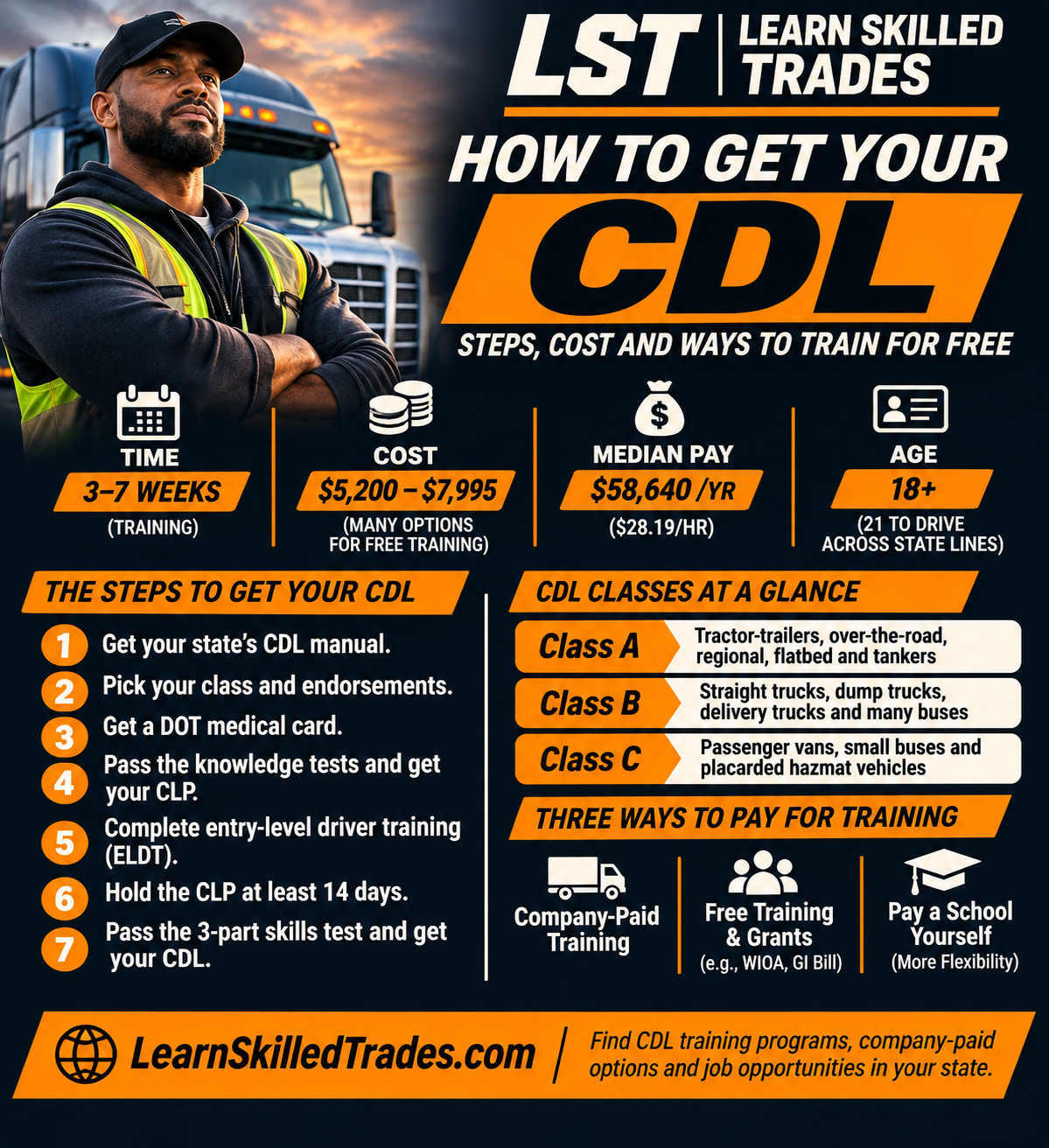
To get a commercial driver’s license (CDL), you pass your state’s knowledge tests to get a commercial learner’s permit (CLP), finish federally required entry-level driver training (ELDT), hold the permit at least 14 days, and then pass a three-part skills test. Most CDL programs take a few weeks. Here’s every step, what each license class lets you drive, what it costs, and three ways to get your training paid for.
Last checked Nov 20 · Written by Lester Burkes, Dean of Trades, Transportation & Apprenticeship and a former Army diesel mechanic.
Quick answer
- Steps: state CDL manual → DOT medical card → knowledge tests and CLP → entry-level driver training → hold the CLP 14 days → skills test → CDL.
- Time: the company programs we checked run about 3 to 7 weeks of training.
- Age: 18 to drive inside your state, 21 to drive across state lines.
- Pay: heavy and tractor-trailer truck drivers earn a national median of $58,640 a year ($28.19 an hour), according to O*NET.
- Cost: the company schools we checked list tuition from $5,200 to $7,995, but many people pay little or nothing through company-paid training or WIOA grants.
Pay: O*NET, heavy and tractor-trailer truck drivers, national median (BLS 2025 wage data). Rules: FMCSA.
Get CDL training and job updates by email
We’ll email you free and company-paid CDL programs and CDL jobs in your state. Free, and you can unsubscribe anytime.
Thank you for your response. ✨
From the dean’s desk
A CDL is virtually an AI-proof career that can lead to six-figure annual wages, and there is so much demand you’re practically guaranteed a job after training.
— Lester Burkes, Dean of Trades, Transportation & Apprenticeship
How to get your CDL, step by step
- Get your state’s CDL manual. Your state, not the federal government, issues CDLs, and each state has its own process. The manual is free online.
- Pick your class and endorsements. Class A for tractor-trailers, Class B for straight trucks and buses (see the class cards below).
- Get a DOT medical card. Most commercial driving requires one. A certified medical examiner does the physical.
- Pass the knowledge tests and get your CLP. Your state also checks your driving record for the last 10 years in every state.
- Complete entry-level driver training (ELDT). If you’re getting a Class A or B CDL for the first time, you must train with a provider on FMCSA’s Training Provider Registry before the skills test.
- Hold your CLP at least 14 days. Some states require longer. Use the time to practice with a qualified CDL holder beside you.
- Pass the 3-part skills test: vehicle inspection, basic controls (backing and maneuvering), and a road test. Then your state issues your CDL.
CDL classes: A, B and C
Combination vehicles of 26,001 lbs or more combined, towing a unit over 10,000 lbs (FMCSA).
Typical jobs: over-the-road, regional, local freight, tankers, flatbed
A single vehicle of 26,001 lbs or more, or one towing a unit of 10,000 lbs or less (FMCSA).
Typical jobs: straight trucks, dump trucks, box trucks, garbage trucks, many buses
Smaller vehicles built to carry 16 or more people (counting the driver) or placarded hazmat (FMCSA).
Typical jobs: passenger vans and small buses, small hazmat vehicles
Take your skills test in the kind of vehicle you plan to drive. Testing in an automatic, for example, usually adds a restriction that keeps you out of manual-transmission trucks.
CDL endorsements
| Code | Endorsement | Tests |
|---|---|---|
| T | Double/triple trailers | Knowledge test |
| N | Tank vehicle | Knowledge test |
| H | Hazardous materials | Knowledge test (plus a background check; first-timers also need ELDT) |
| X | Tank + hazmat combined | Knowledge test |
| P | Passenger | Knowledge and skills tests |
| S | School bus | Knowledge and skills tests |
A CLP can carry only three endorsements: passenger, school bus and tank vehicle, with limits on each while you’re learning.
How old do you have to be to get a CDL?
You can get a CLP or CDL at 18 and drive inside your state. To drive a commercial truck across state lines, federal rules say you must be 21. FMCSA’s Safe Driver Apprenticeship Pilot let some 18-to-20-year-olds drive across state lines with participating employers, but that pilot has ended. An extension is under review, so for now plan on 21 for interstate driving.
Three ways to pay for CDL training
- Company-paidA trucking company trains you, often paying you while you learn. In return you drive for them, usually about a year. Leave early and you may owe the cost.
- Free training and grantsYour local workforce office (American Job Center) may pay for CDL school through WIOA if you qualify. Veterans can use the GI Bill at approved schools.
- Pay a school yourselfCommunity colleges and private schools on FMCSA’s Training Provider Registry. You can drive for any company afterward, and some carriers reimburse tuition.
See the full side-by-side list of companies that pay for CDL training, including how long you have to stay and what’s posted about leaving early.
How long does it take to get a CDL?
Count on a few weeks of training plus testing time. Roehl’s and Swift’s programs list 3 weeks of school, and Schneider’s apprenticeship lists 5 to 7½ weeks. Federal rules add at least 14 days between getting your permit and taking the skills test, and your state’s testing schedule can add more.
How much do CDL drivers make?
O*NET lists a national median of $58,640 a year ($28.19 an hour) for heavy and tractor-trailer truck drivers. The top 10% earn $79,380 or more, and the bottom 10% earn $40,140 or less. Pay depends on the kind of driving: local, regional or over the road, team or solo, and what you haul.
Frequently asked questions
Do I need CDL school to get a CDL?
If you’re getting a Class A or Class B CDL for the first time, yes: you must complete entry-level driver training with a provider listed on FMCSA’s Training Provider Registry before you take the skills test.
Can I get my CDL for free?
Often, yes. Trucking companies will train you in exchange for a work commitment, and local workforce offices can pay for training through WIOA if you qualify. Free doesn’t always mean no strings, so read the terms.
Class A or Class B: which should I get?
Class A lets you drive tractor-trailers and, in most cases, Class B vehicles too. It opens the most jobs. Class B fits local jobs like dump trucks, delivery straight trucks and buses.
Can I take the skills test right after I get my permit?
No. Federal rules require you to hold your CLP for at least 14 days first, and some states require longer.
Sources
- FMCSA: How do I get a Commercial Driver’s License?
- FMCSA: CDL classes, endorsements and ELDT for drivers
- FMCSA: Age requirement for interstate commerce
- U.S. DOT: request for comment on an exemption after the Safe Driver Apprenticeship Pilot ended
- FMCSA Training Provider Registry
- O*NET: Heavy and Tractor-Trailer Truck Drivers wages (53-3032.00)
- Roehl: Get Your CDL · Swift Academy · Schneider CAT · Knight CDL Academy

Leave a Reply